From DVDs to marquees.

Nick Park’s beloved characters have been with him for more than three decades. “I can trace the roots of Wallace and Gromit back to when I did a degree at Sheffield’s art school in the U.K.,” he tells Queue. When he started his graduation project at the National Film and Television School, Park returned to his sketchbook — and to Wallace and Gromit. He began working on A Grand Day Out, a space-bound stop-motion short film that used a literal ton of clay to build its miniature world.
Inspired by such varied touchpoints as Hergé’s Tintin comics and the films of Alfred Hitchcock, Park dreamt up a dynamic duo all his own: a cracking inventor named Wallace and his faithful, perpetually knitting pooch Gromit. He stamped the concept with a distinctly personal flair. “I wanted something that started near my roots up in Preston in the north of England, where you have little red brick houses with slate roofs and a big factory behind them,” Park says. “But in this little house were some working-class individuals who had harebrained schemes. So, big things started in humble little places.”
Big things, indeed. After graduating from film school, Park still hadn’t finished A Grand Day Out. A connection with Peter Lord and David Sproxton, the founders of Aardman animation studio, gave him a push to the finish line. The pair were looking for clay animators, and they brought him on part-time while he finished his trip into stop-motion outer space.
In between Aardman assignments, like Peter Gabriel’s “Sledgehammer” music video, Park tinkered with his own film. Stop-motion animation takes time; each frame is photographed individually, producing only seconds of footage per day. “All together it took seven years,” Park says of A Grand Day Out. When the film was finally finished, it nabbed an Oscar nomination for Best Animated Short Film — though it was bested by another of Park and Aardman’s creations, Creature Comforts, which brought home the win.
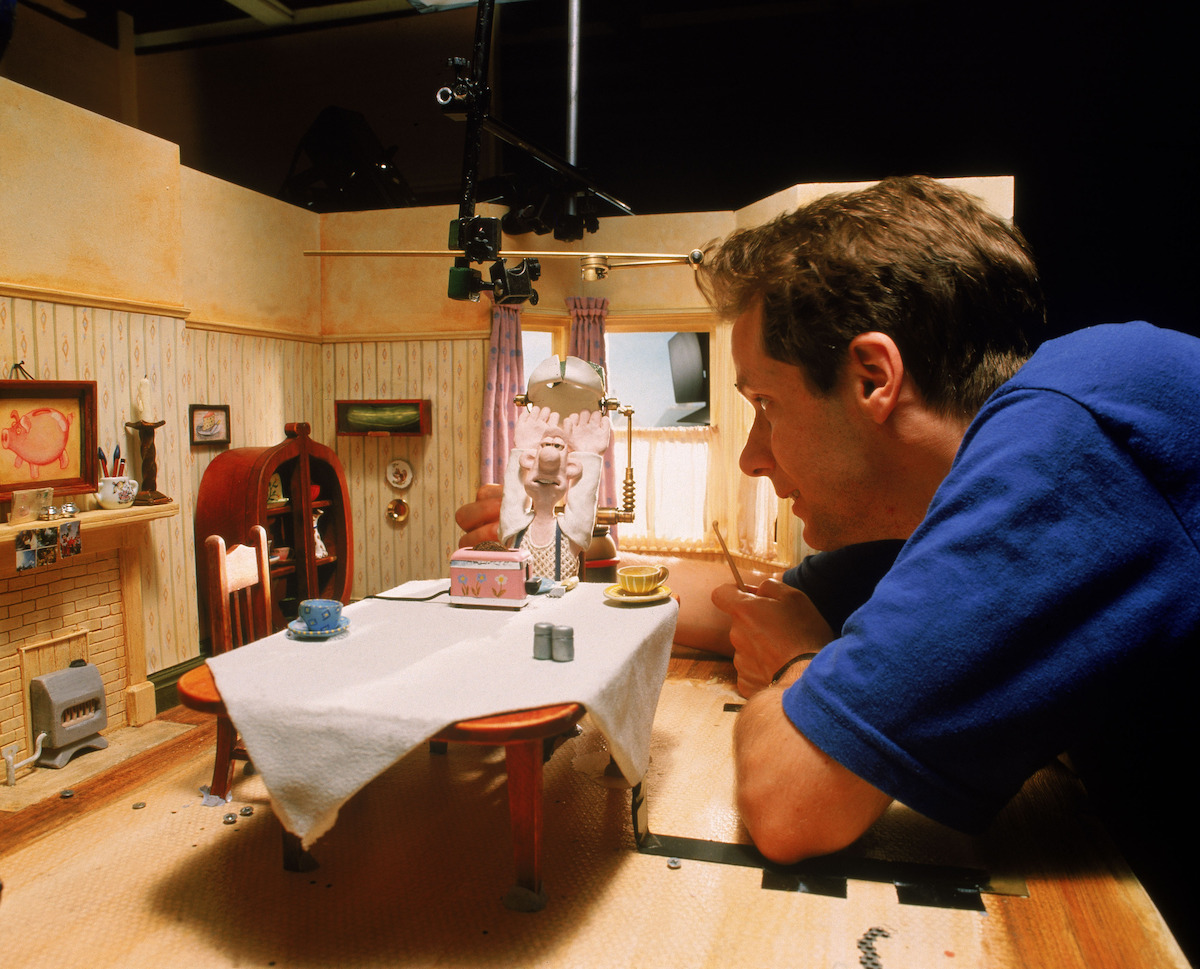
Nick Park on the set of The Wrong Trousers in 1992
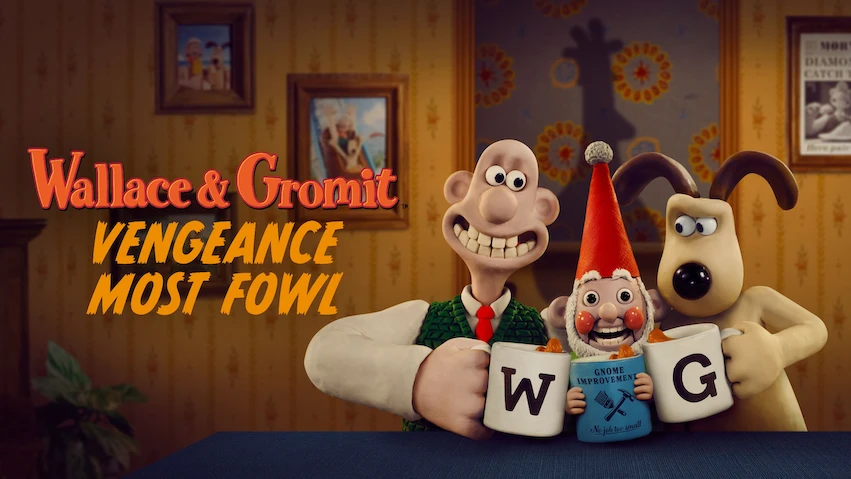
In the 35 years since, Park’s gone on to direct or co-direct memorable Aardman films like Chicken Run and Early Man, but he’s always returned to his beloved art school creations. He and Aardman have produced three subsequent Wallace & Gromit short films and one feature, all of which were also nominated for Oscars (three of them won). And all these years later, Park is still molding the dynamic duo: The feature film Wallace & Gromit: Vengeance Most Fowl, which he directs with Aardman alumni Merlin Crossingham, hits Netflix this winter.
Park remains a little perplexed by the global attention his little student film project continues to receive. “I think the world is full of dog lovers, pet lovers, and so Gromit appeals,” he muses. “There’s also that thing of everyone tending to look at their pet as having human emotions and thoughts, so I think that [for that reason it] also [resonates].”
In Park’s original conception, Gromit would have had a lot more than thoughts. The first clay-molded Gromit had a mouth, and Park expected to eventually lend him an actor’s voice, Scooby-Doo style. “I actually recorded it,” he remembers.
But on the first day of filming, Park set up a shot and realized Gromit’s mouth would be too hard to access. “It was so hard to get to Gromit’s mouth underneath this table that I just moved his brow up and down,” he says. “And in that moment I discovered that Gromit could express everything he needed by just moving his brow. In a way, [that’s when] Gromit was born.”
On the set of Vengeance Most Fowl, animators whisper that Park shares a few mannerisms with his most famous human character: exaggerated blinks, a big smile. “Because it all came from me in the first place, a lot of Wallace and Gromit was me unconsciously making up stuff,” he says. “When you’re thinking of a scene, how would Gromit or Wallace react? You maybe even have a mirror. Now we can actually video ourselves to help communicate with the animators.”
Facial tics aside, you won’t be surprised to learn that Park relates far more to Gromit than he does to Wallace. “I think Gromit very much is me,” he says. “I’m a fairly introverted person, so I always try to avoid having him doing typical things in front of the camera. It’s about what someone would do who’s a bit awkward.”
As far back as his first Oscar-winning short film, Creature Comforts, Park has injected this endearing awkwardness into his characters. Creature Comforts enhanced audio from real interviews by transposing it onto stop-motion footage of clay zoo animals, from monkeys to polar bears. “It’s about what happens to people when you stick them in front of a camera and stick a microphone on them,” Park says. “I find clay particularly lends itself to observational humor.”
The Wallace & Gromit films are comedies, but they’re also capable of leaping into thrilling action sequences at the drop of a hat. “I’ve always found myself quite at home doing action sequences,” Park says. “All the films have got big ones.” In 1993’s The Wrong Trousers, a haywire pair of mechanical pants becomes the lynchpin of a model train chase that draws just as much from Buster Keaton’s The General as it does from Tom and Jerry. “It’s like a slow-burn thriller-slash-heist movie that suddenly bursts into this absolutely madcap Hollywood-style train chase, like a cowboy movie,” Park says.
Park still holds The Wrong Trousers up as the high watermark of his work with Wallace and Gromit. “When you’re young, I think you have this confidence just to try things out,” he says. “And there was no real pressure because people had only seen A Grand Day Out at that point, so the world was our oyster.”
Of course, after youthful confidence comes adult anxiety. “I remember I was really nervous at the time thinking, Will this work? Will it be something an audience won’t find too weird or strange?” Park adds. “But no one’s had a complaint.” Quite the contrary: Years later, the penguin villain of The Wrong Trousers is returning for Vengeance Most Fowl, to fans’ delight.
Some of the younger animators carefully positioning Wallace and Gromit’s models for Vengeance Most Fowl grew up fans of films like The Wrong Trousers. But many other members of the production have been with Park and Aardman since the very beginning. “A lot of those people came from film school at the same time as me,” Park says. “Even now, we have Julian Nott, the composer; we were at film school together. Adrian Rhodes, the sound designer [too]. And then [cinematographer] Dave Alex Riddett, he was at Aardman when I joined, and he gave me advice filming A Grand Day Out.”
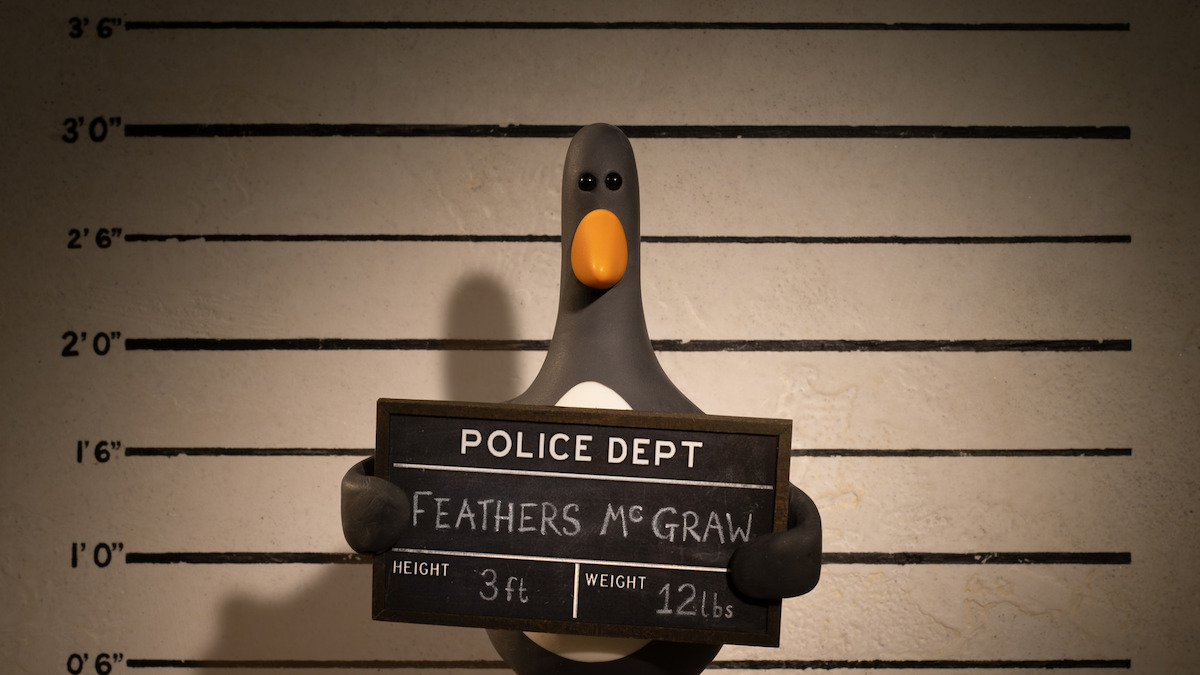
Feathers McGraw
What keeps this crew coming back is the handmade, hands-on quality of stop-motion animation. “You could build real sets and get down there with a camera and light it like a real movie,” Park says of his initial decision to make A Grand Day Out in stop-motion. “It had dimensions, you could have camera moves.”
But there’s also something perfectly imperfect about the medium, an idea perhaps best exemplified by the fingerprint marks that you can still see in the pliable Aardman clay. “Many animators, because they want to do the job so well, often smooth it out to such a fine degree,” Park says. “We discourage them because we want to show the clay; we want people to see what it’s made of, which is quite antithetical to a lot of the industry, which is trying to go for more realism, [more] slick. But I like the fact that we’re an antidote to that. That the clay speaks for itself.”